The 7 Habits of Effective Agentic Systems
Effective agentic systems are governed components with clearly bounded roles that are embedded into workflows which reduces ambiguity, improves decisions, and provides measureable outcomes.
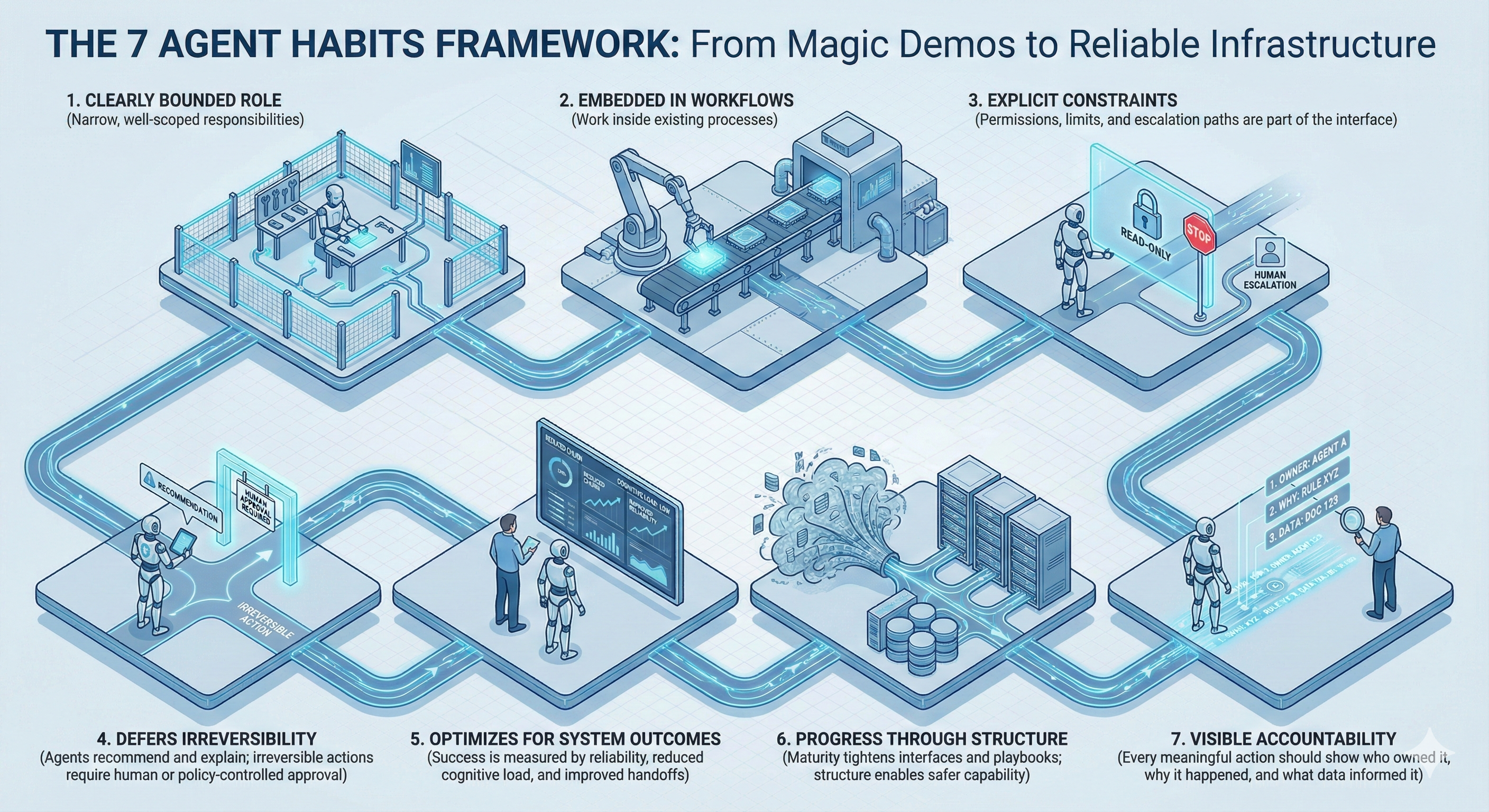
TL;DR: This framework captures seven practical habits that make agents safe, useful, and auditable in production:
- Clearly Bounded Role — narrow, well-scoped responsibilities that limit blast radius and set clear expectations.
- Embedded in Workflows — agents work inside existing processes, producing structured signals humans and systems can act on.
- Explicit Constraints — permissions, limits, and escalation paths are part of the interface, not an afterthought.
- Defers Irreversibility — agents recommend and explain; irreversible actions require human or policy-controlled approval.
- Optimizes for System Outcomes — success is measured by reliability, reduced cognitive load, and improved handoffs.
- Progress Through Structure — maturity tightens interfaces and playbooks; structure enables safer capability.
- Visible Accountability — every meaningful action should show who owned it, why it happened, and what data informed it.
To see these habits in action, check out the Resources page for a curated list of articles, projects, and other real-world examples.
Each habit is defined independently and includes intent, scope, governance implications, common failure modes, and examples. See also Applying the Habits in Practice page for examples and practical guidance.
Use governance as the lens: if a habit is missing or reversed, treat it as a governance failure to investigate.
They are governed components designed to reduce ambiguity, improve decisions, and increase system reliability without replacing accountability. See the Governance page.
This project defines these as a canonical set of habits observed in agentic systems that reliably create value in real production environments.
Why This Exists
As AI agents become more capable, many teams attempt to give them broad autonomy across workflows, systems, and business processes.
The result is often predictable.
Systems become harder to reason about. Accountability blurs. Failures become surprising instead of diagnosable.
This project exists to offer a different framing.
Rather than asking what agents can do, it focuses on where agents belong.
Rather than optimizing for autonomy, it optimizes for reliability, governance, and system outcomes.
What This Is
This is a design framework.
It provides a shared language for engineers, architects, and executive leaders to reason about agentic systems.
The habits defined here are not steps, rules, or guarantees. They are patterns that tend to emerge when agentic systems are designed intentionally and operated at scale.
What This Is Not
This is not a tutorial.
It is not a maturity model, a reference architecture, or a vendor comparison.
It does not claim completeness, nor does it prescribe a single correct implementation.
Open Source and Contribution
This project is open source and intentionally curated.
Contributions are welcome in the form of examples, failure analyses, tools, and critiques that map to existing habits.
The habit definitions themselves are stable and versioned to preserve clarity and continuity.
If you are designing, deploying, or governing agentic systems, this framework is meant to be used, questioned, and improved.
Status
This page represents the current canonical version of the Agentic Systems Habits framework.
Revisions are intentional, documented, and guided by real-world experience.
Created and Curated by: Inbar Rose — https://inbarrose.com